
Salt damage survey - List of Manufacturers, Suppliers, Companies and Products | IPROS

Salt damage survey Product List

1~2 item / All 2 items

Displayed results

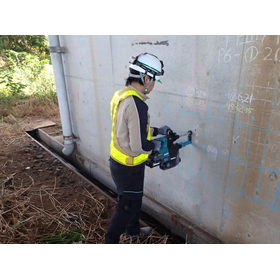
Salt damage investigation (salt analysis and corrosion survey for concrete and steel structures)

Visualize the salt content and accurately grasp the deterioration progress of structures that can be utilized in longevity planning.

Salt damage investigation is a survey conducted to evaluate whether concrete structures and steel materials are deteriorating due to the effects of salts contained in sea salt and de-icing agents. It is carried out on various structures, primarily focusing on social infrastructure such as bridges, buildings, port structures, and road structures. Our company conducts sample collection using the drill method or core method and quantitatively assesses the penetration of salts by analyzing the amount of chloride ions at different depths. Furthermore, by combining this with rebar detection using electromagnetic radar methods, we can correlate the positions of rebar with the amount of salt, allowing for a more detailed assessment of the progression of salt damage. Additionally, by conducting natural potential measurements and rebar exposure surveys, we can confirm the presence of rebar corrosion and the areas that require repair, providing valuable data for the consideration of maintenance and repair plans.

  • Consulting companies
  • Structural Survey
  • Non-destructive testing
  • Salt damage survey

Added to bookmarks

Bookmarks list

Bookmark has been removed

Bookmarks list

You can't add any more bookmarks

By registering as a member, you can increase the number of bookmarks you can save and organize them with labels.

Free membership registration

Investigation of salt damage in concrete using X-ray fluorescence analysis.

This introduces a study on salt damage in concrete using X-ray fluorescence analysis.

Concrete structures face issues such as a decrease in strength when chloride ions penetrate the concrete due to airborne salt and the application of de-icing agents. Therefore, it is important to regularly examine the amount of chloride ions in the concrete. Traditionally, the potentiometric titration method has been widely used, but it has problems such as high analysis costs and time consumption. The fluorescent X-ray analysis method is now gaining attention because it allows for the high-sensitivity and simple measurement of chloride content in concrete on-site.

  • Non-destructive testing
  • Salt damage survey

Added to bookmarks

Bookmarks list

Bookmark has been removed

Bookmarks list

You can't add any more bookmarks

By registering as a member, you can increase the number of bookmarks you can save and organize them with labels.

Free membership registration